Transferred from A&E to the general ward
08 April 2026
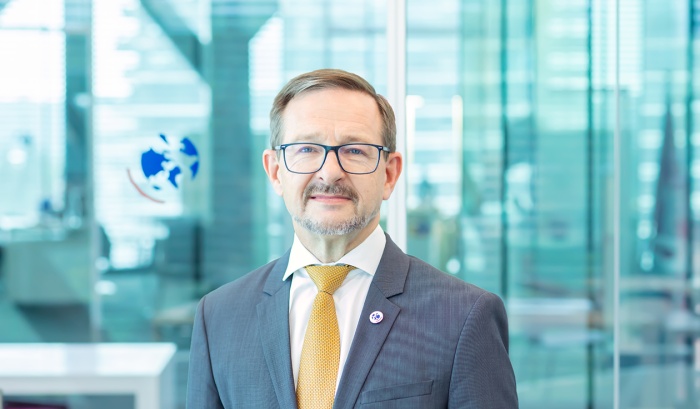
At the Organisation for Security and Co-operation in Europe (OSCE), business continues as usual: dialogues and visits to the Balkans, meetings of ‘forums’ and ‘committees’, a parliamentary conference, and a ‘Supplementary Human Dimension Meeting’ in Vienna attended by 450 participants. The first quarter of the Swiss Chairmanship ended on a high note: a budget has been successfully adopted. The 57 member states had failed to achieve this over the previous five years. We asked Ambassador Thomas Greminger, Executive Director of the Geneva Centre for Security Policy (GCSP) and, as a former Secretary General, a shrewd expert on the organisation, how significant this agreement is.
Thomas Greminger, the Chairperson of the OSCE, Federal Councillor Cassis, has announced an agreement on the organisation’s budget. How significant is this?
It is certainly very important, because the OSCE has not had a regular budget for almost five years, with very serious operational implications. For example, it is no longer possible to enter into commitments extending beyond a few months. This also has political consequences. The inability to adopt a regular budget was a clear sign of the OSCE’s paralysis. With the agreement on a budget, the organisation has now, so to speak, moved from the A&E department to the general ward of the hospital. But fundamentally, of course, nothing has changed.
What do you mean by ‘nothing’?
The polarisation. Everything to do with the war in Ukraine. Swiss diplomacy has managed to secure a budget, which is important for the organisation to function. But that hasn’t given them any greater political leeway.
Has the war of aggression against Iran changed the situation in Vienna in any way?
Only indirectly. There may well be direct factors that I haven’t picked up on. But viewed from a distance, the war in Iran has meant that the conflict resolution process regarding Ukraine, which was facilitated by the Americans, has lost political momentum, and with it the prospect that a resolution to the conflict and a ceasefire would be reached at some point in the next few months. I believe this hope has suffered a further setback. And with it, the chance that the political environment in which the OSCE operates could change fundamentally in the foreseeable future.
The Swiss Chairmanship always emphasises that the OSCE could play a role once a ceasefire is in place, and that it must be prepared to do so. The talk is of monitoring ceasefire lines, election observation and prisoner exchanges. To what extent is your organisation, the GCSP, involved in such preparations?
I would distinguish between two things. The first concerns the preparations being made at the Secretariat level in Vienna or within the OSCE institutions. I am confident that these preparations will be at a stage where a corresponding operation – be it ceasefire monitoring or election observation – could be launched. The other aspect is what we are undertaking at the Geneva Centre for Security Policy. We have been working on ceasefire modalities for years, with leading ceasefire experts, including those from the OSCE region. People who have seen what worked and what did not between 2014 and 2021 within the framework of the ‘Special Monitoring Mission to Ukraine’. The feedback we have received on this from the Conflict Prevention Centre of the OSCE Secretariat is positive.
Before the terms of a ceasefire can be implemented, the parties to the conflict must agree on them. What is the current state of the negotiations?
Unfortunately, the current state of negotiations does not appear to envisage any role for an international organisation. What we are hearing from the negotiations is the idea that the Americans would be tasked with ensuring monitoring. I do not have detailed insight into these negotiations, nor do I know whether, at a later stage, consideration might still be given to involving international organisations – for example, if the Americans realise the political responsibility they would be taking on by undertaking this ceasefire monitoring. I cannot imagine that the MAGA world would be pleased about that.
If we look beyond Ukraine and consider the pan-European security situation, the policy of détente of the 1970s comes into focus. The OSCE, which brought East and West together, is, so to speak, a product of détente. It has its origins in the Conference on Security and Cooperation in Europe (CSCE) in Helsinki. To what extent can the current situation be compared with that of the past?
The comparison is certainly interesting. The CSCE, the cornerstone of détente, was launched in a world that was entirely dominated by confrontation and deterrence…
…would the first pillar be deterrence through confrontation?
Yes. Today, the prospects for a European security order – as they are likely to present themselves in the coming years – are once again dominated almost exclusively by deterrence and confrontation. This raises the question of whether there is potentially any political scope for the second pillar, what was once called détente or dialogue. At the moment, this is not apparent. However, it is entirely conceivable that a window of opportunity might open again for a conference such as the CSCE if the war in Ukraine can be brought to an end and the outcome is reasonably acceptable to the key players. This two-pillar strategy was known within NATO as the Harmel Doctrine. It dates back to 1967. This doctrine was crucial in enabling the second pillar and the Helsinki Process to be launched in 1972.
Is the US open to such an idea within NATO?
The latest thinking coming out of the US Pentagon is very interesting. Elbridge Colby, the Under Secretary of Defence for Policy, has, among other things, spoken of ‘NATO 3.0’ in recent weeks and explicitly mentioned the Harmel Doctrine. He is advocating a return to this doctrine. The fact that one of the leading security strategists in the US government – whom I happen to know, by the way – is saying such things fills my heart with joy. However, when I look at current American policy in practice, I find myself lacking faith at the moment.
There are, of course, forums where people can talk to one another. One such forum where Russian and Western representatives engage in dialogue is the GCSP. What exactly happens there?
We have several such platforms. We call one very confidential one the ‘back channel’. It deals directly with the war in Ukraine and is made up of experts who are very well connected within their respective presidential administrations. These are Russians, Ukrainians and Americans, as well as some key Europeans. This platform still exists, but has taken somewhat of a back seat at the moment whilst official negotiations are underway. We will have to see when we can reactivate it. Then, for several years now, we have had a platform that is considering how a European security order might be rebuilt once the war has ended. We call this platform ‘Conversations about the Future of European Security’. We have produced an interim graphic document, the ‘peace matrix’, which we are currently consulting on in the key capitals. These are not yet mainstream considerations, but rather expert reflections on the building blocks needed to rebuild a European security order. They could eventually be brought back into the OSCE once the political situation is ripe. I am also discussing this with my Swiss colleagues. Then we have platforms that are more focused on US-Russia relations. One is called ‘US-Russia Relations in a Multipolar World’ and essentially seeks to explore the scope for a normalisation process. Under the current circumstances, the scope for normalisation is minimal; if there is an end to the war in Ukraine, it will expand. But it will take years to rebuild the trust that has largely been lost. The good news is that, once the war ends, there is potential for normalisation. The bad news is that even then, it will take years for relations to return to normal.
In the CSCE process of the 1970s, there was talk of confidence-building measures – perhaps even small steps that can change the atmosphere. Are there such building blocks in your framework?
There are certain hypotheses. There are measures we classify as de-escalation, measures relating to the protection of Ukrainian sovereignty and statehood, and matters concerning the reconstruction of a new order. The big question is that of sequence. Basically, we say that the sequencing, the order of the steps, will have to be guided by the political environment. There are measures that, in normal logic, would come later but then suddenly take precedence, for example arms control components. Normally, one must first engage in military risk reduction, then one can plan confidence- and security-building measures, and at some point arms control follows. But perhaps the dynamics of conflict resolution could lead to this sequence being altered. When it comes to confidence-building measures, I am thinking more of the societal sphere, as we know them from the 1970s and 1980s. At the moment, it is all very difficult to envisage, but we are keeping it on our radar. The Vienna Document …
... The agreement between OSCE states on transparency and confidence-building in the military sphere, first signed in 1990 and last revised in 2011…
In practice, it is largely no longer applied today. In its current form, the Vienna Document cannot simply be brought back into force, as it were. A whole range of its components remain relevant, but they will need to be adapted to the times. That is, when the political climate allows.
What would the social measures be – that is, the non-military ones? In the 1970s, these were human rights, fundamental rights and civil liberties. In today’s political climate, they seem more like stumbling blocks. Washington and Moscow could get along without harping on about these rights. Russia rejects any suggestion that the introduction or observance of fundamental rights constitutes Western imperialism, and in the US it is not necessarily a top priority either.
These are certainly not the measures that will come into play in the very earliest phase. It is more a matter of re-establishing people-to-people contacts, more student exchanges, cultural exchanges – simply deepening the network of relationships once again. But I would not rule out the possibility that, as such measures are stepped up, the human rights agenda will also regain prominence. I recently had a very interesting conversation with the Council of Europe’s Commissioner for Human Rights, who is very insistent that a resolution to the conflict in Ukraine should be shaped in a way that is as consistent as possible with human rights. This is not just about accountability for war crimes. It is very important to restore human rights to the role they must play if we are to build a sustainable peace.
How much can Switzerland, as the chairing country, do to drive forward what we are discussing now – a new security order, greater confidence-building? Shouldn’t it, as the chairing country, exercise restraint instead, given that it needs to act as a balancing force?
Switzerland cannot set the agenda in this regard. No OSCE Chairperson can do that. A Chairperson can, however, explore the scope for action and prepare the ground. Informal platforms can be used for this purpose. Not yet platforms involving all 57 members, as the limits are relatively narrow at the moment; many of these issues cannot yet be addressed within an inclusive framework. What can be done, however, is to create informal spaces to test out some of these questions. For example, one can collaborate with actors working at the track-two level, as we do.
Is Switzerland active in this area?
The diplomatic community in Bern is certainly keeping a close eye on this. It is not just a question of the OSCE potentially taking over ceasefire monitoring in Ukraine; the broader picture is also very much in view. There are certain OSCE platforms that could be utilised for this purpose, such as the Structured Dialogue, which was established by the German Chairmanship ten years ago. It is not currently being used by all 57 participating States, but it still exists, with Norway at the helm. This platform could be used, following the conclusion of a peace agreement in Ukraine, to resume initial inclusive discussions within the OSCE on a security framework. Things can then move very quickly, and one must have ideas ready and know who to talk to.
Disclaimer
This article was originally published on the Schweizerische Gesellschaft für Aussenpolitik website in Swiss German. The views, information and opinions expressed in this publication are the author’s/authors’ own and do not necessarily reflect those of the GCSP or the members of its Foundation Council. The GCSP is not responsible for the accuracy of the information and translation.
Expert