Türkiye and other middle powers can help shape a fairer global order
26 November 2025
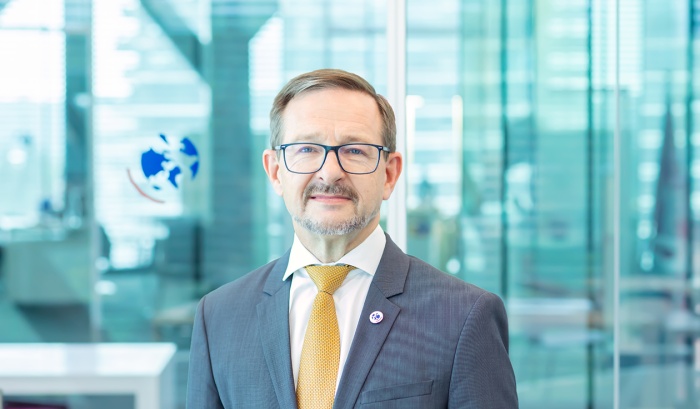
At the 9th TRT World Forum in Istanbul, Ambassador Thomas Greminger said Türkiye, along with other middle powers, can play a pivotal role in steering the global reset and strengthening multilateralism amid rising US-China rivalry.
As great power rivalry intensifies between the United States and China, Türkiye and other middle powers have both a “responsibility and capacity to shape the global reset” toward a more predictable and rules-based international order, says Ambassador Thomas Greminger, Director of the Geneva Centre for Security Policy and former Secretary-General of the Organization for Security and Co-operation in Europe (OSCE).
Speaking to TRT World on the sidelines of the 9th TRT World Forum in Istanbul, where he joined a high-level session titled “The Return of High-Stakes Diplomacy: Middle Powers and the Emerging Multipolar Order,” Greminger emphasised the vital role of middle powers in reviving effective multilateralism amid growing uncertainty in global politics.
“Türkiye and other middle powers have both an interest in a predictable multilateral system based on the rule of law and clear norms, and the capacity to shape that order,” he said. “They should not allow themselves to be drawn permanently into the rivalry between the US and China.”
A coalition for rebuilding European security
Drawing on his experience at the OSCE, Greminger pointed to historical precedents such as the Helsinki Process of the 1970s, when neutral and non-aligned states helped stabilise Europe’s security order during the Cold War.
He argued that, once the war in Ukraine ends, a new coalition of middle powers will again be needed to reconstruct European security architecture. “The neutrals and non-aligned don’t exist anymore, so we need a new coalition,” he noted.
“I see Türkiye investing rightly in this direction — the appointment of a highly capable Turkish diplomat as the new OSCE Secretary-General is an investment in rebuilding European security,” Greminger added, referring to veteran Turkish diplomat Feridun H. Sinirlioglu, who took charge as the OSCE chief in December 2024.
Greminger said Türkiye’s unique diplomatic positioning — maintaining dialogue with multiple sides while championing multilateral cooperation — puts it in an advantageous role to contribute to peacebuilding and institutional reform.
Greminger said that while the conflict in Ukraine is far from attaining sustainable peace, there has been some movement compared to a year ago.
“In Ukraine, we are closer to the parties resuming negotiations on a ceasefire and settlement,” he said. “We need a combination of US leverage to bring both sides to the table and smart diplomacy that middle powers like Türkiye can help facilitate.”
He stressed that genuine conflict resolution will require cooperation among both major and middle powers to combine influence with nuanced, inclusive diplomacy.
Caution on the ‘G2’ narrative
The TRT World Forum 2025, themed “Global Reset: From the Old Order to New Realities,” took place just days after the meeting between US President Donald Trump and Chinese President Xi Jinping in the South Korean city of Busan — a meeting Trump described as a “G2 summit,” invoking the idea of Washington and Beijing as co-leaders of global affairs.
While acknowledging the importance of US-China cooperation, Greminger cautioned against a bipolar world order.
“We all have an interest that the two (the US and China) manage their strategic rivalry and avoid turning it into something hot, like a conflict over Taiwan. Nobody wants that,” Greminger observed.
“But what is not in our interest is that they divide the world Yalta-style into spheres of influence and use this setup to dominate others. That’s not what we want,” he said, alluding to the Yalta Conference held after World War II in 1945 to discuss the postwar reorganisation of Germany and Europe.
He said stability in trade and global policymaking between Washington and Beijing would benefit all, but warned against any arrangement that sidelines other actors or undermines multilateral institutions.
Instead, Greminger argued, middle powers can play a stabilising role in ensuring the rivalry remains manageable and rules-based.
‘The world is bigger than five’
Commenting on Turkish President Recep Tayyip Erdogan’s long-standing call to reform the United Nations under the slogan “The world is bigger than five,” Greminger said he shared the Turkish leader’s vision, emphasising that the global community must move beyond the outdated power structures inherited from the post–World War II era.
“We have to overcome a way of looking at the world that made sense immediately after World War II,” he said. “We need to come up with a new allocation of labour. My call is not only to focus on reforming the UN Security Council — that’s important, of course — but also to make all multilateral institutions fit for purpose, efficient, and effective.”
Greminger praised Türkiye’s advocacy for a fairer international system, describing Erdogan’s stance as “political leadership that is needed to push global institutions toward reform.”
In Greminger’s view, the post-Cold War Western optimism about a unipolar, rules-based world has long faded. What replaces it, he suggested, will depend not just on the behaviour of the superpowers but also on the capacity of middle powers to cooperate across regions and traditions.
“Middle powers must avoid being drawn into binary rivalries,” he reiterated. “They can align with major powers on certain issues but retain autonomy on others — that’s how they preserve strategic flexibility and help build a more stable, multipolar order.”
As the 9th TRT World Forum drew to a close, Greminger’s reflections underscored a recurring theme across this year’s discussions: the growing influence of middle powers in defining a new balance in global diplomacy.
“Middle powers have both a responsibility and a capacity to shape this reset,” he concluded.
Disclaimer
This publication is originally published by the TRT World website. The views, information and opinions expressed in this publication are the author’s/authors’ own and do not necessarily reflect those of the GCSP or the members of its Foundation Council. The GCSP is not responsible for the accuracy of the information.
Expert