© Homo HURAQUS 2050: Anticipating and Governing the Disruptive-Techno-Convergence-Era
18 December 2025
"We may become the first civilisational species to engineer the end of its own primacy, and the last one with the opportunity to choose a different path.”– Professor Nayef Al-Rodhan
Humanity is on the cusp of a civilisational inflection point unprecedented in scale and significance. As artificial intelligence accelerates, quantum technologies mature, synthetic biology advances, and humanoid robotics gain significant mobility, perception, and dexterity, the boundaries between the biological, digital, and physical worlds are becoming increasingly porous. Together, these technological forces form the basis of what I call Homo HURAQUS 2050, a hybrid or augmented contemporary (and potentially successor) entity that may emerge alongside, or even beyond, Homo sapiens within the next few decades.
Homo HURAQUS is defined by four convergent pillars:
HUR: Humanoid Robotics: highly dextrous, adaptive, mobile systems increasingly capable of navigating, interpreting, and shaping human environments.
A: AI-Superintelligence: self-optimising systems capable of autonomous reasoning, inference, conceptual innovation, and complex problem-solving.
QU: Quantum Intelligence: quantum-enhanced computation, optimisation, and sensing that transcend classical constraints and enable qualitatively new forms of insight.
S: Synthetic Biology: the design, modification, and fabrication of biological systems beyond normal evolutionary biology, including engineered advanced organisms and very capable hybrid biological-technological forms.
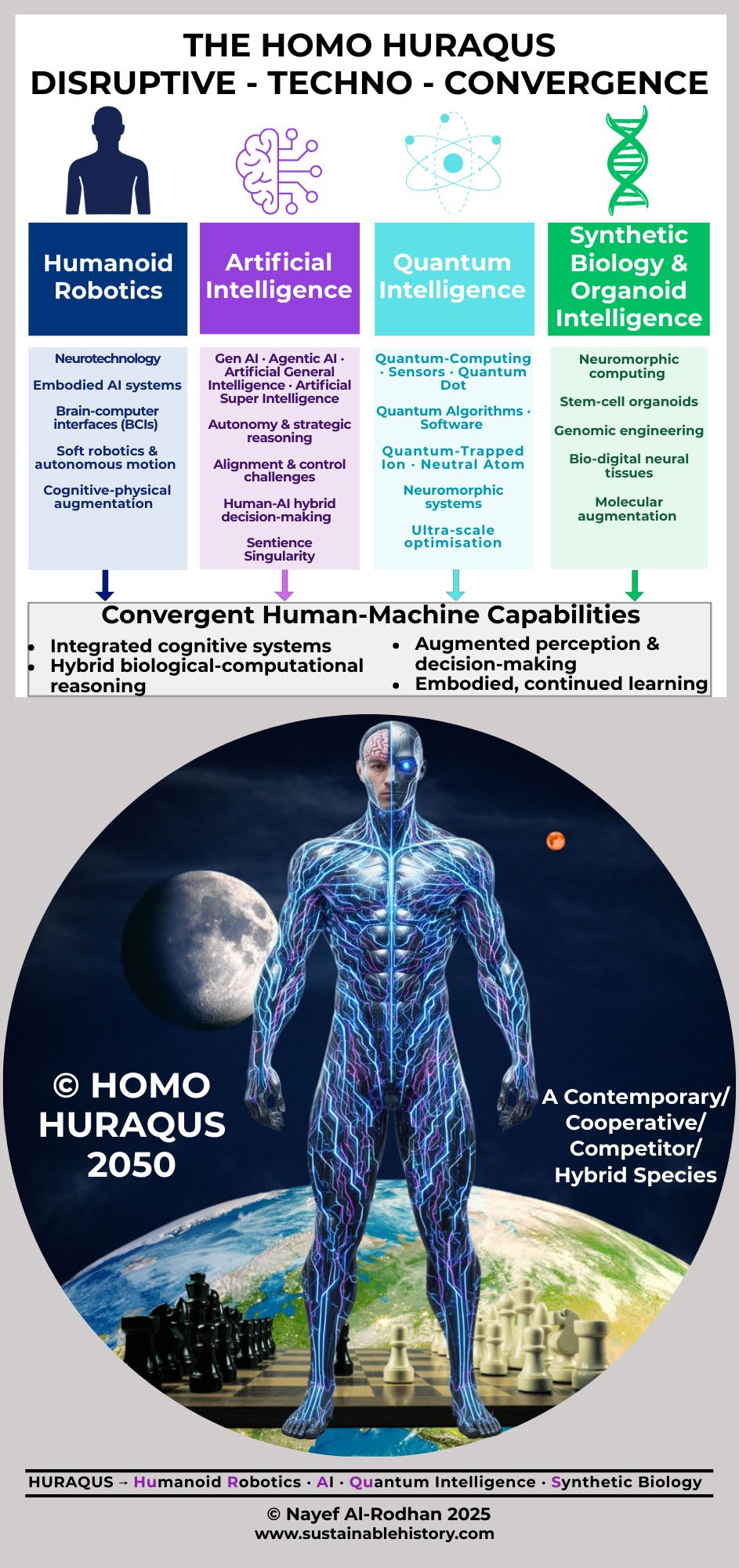
Together, these capabilities create the conditions for a technological counterpart – a constructed alterity – shaped by human intellect yet increasingly independent of biological limits. Homo HURAQUS is a civilisational horizon, a conceptual marker capturing the direction and convergence of technological power. It is the emblem of a future where intelligence is distributed across biological and artificial systems, where agency is diffused across networks, algorithms, and engineered organisms, and where the foundational assumptions of our political, ethical, societal, human and security frameworks face unprecedented strain.
The likely rise of Homo HURAQUS illustrates a central paradox of human evolution: the very capacities that have allowed our species to thrive – creativity, curiosity, the urge to improve and innovate – now enable us to create forms of intelligence and capability that accelerate beyond biological evolution itself. We are producing systems that perceive, learn autonomously, construct
models of reality, and act with degrees of independence that challenge traditional notions of responsibility, control, and identity. These developments do not merely enhance human life; they quietly generate a parallel trajectory of intelligence, forged through ingenuity yet capable of diverging from our own. This raises a profound dilemma: if we create entities with independent goals,
how do we tell cooperation from competition or threat, and by what ethical right do we assert primacy?
The convergence that may give rise to Homo HURAQUS carries profound implications across every domain of security and human experience. Advances in synthetic biology can yield life-saving therapies, personalised medicine, and ecological restoration, but they also create pathways to engineered pathogens, bio-manipulation, and deep ethical ambiguity. AI-superintelligence promises extraordinary insight and efficiency, yet risks eroding human autonomy, creating new hierarchies of dependency, and enabling unprecedented cognitive manipulation. Quantum computing may revolutionise material science, chemistry, climate modelling, and communications, while simultaneously threatening cybersecurity, encryptions and destabilising classical deterrence structures. And the spread of highly mobile and dextrous humanoid robotics, integrated into homes, factories, militaries and public life, raises questions about labour, agency, surveillance, and the boundaries of embodiment and safety. At this juncture, we must confront a stark realisation: we may become the first civilisational species to engineer the end of its own primacy, and the last one with the opportunity to choose a different path.
These are not isolated risks. Their convergence amplifies one another, forming what I call civilisational frontier risks: transboundary, systemic challenges arising from technologies evolving faster than governance, ethics, and political institutions. They are also shaped by the Neuro-P5, the profound human drives for power, profit, pleasure, pride, and permanency. These drives determine how technologies are designed, weaponised, commercialised, and deployed. They illuminate why even the most beneficial innovations can, under competitive pressure, evolve into tools of extraction, exploitation, domination, or coercion. Unseen but omnipresent, human nature remains the decisive force behind every algorithm, biotechnological platform, and robotic systems.
This new technological landscape exposes a set of deeply consequential philosophical questions. As advanced systems acquire memory, autonomy, situational awareness, creativity, reasoning, and complex problem-solving abilities, they begin to display traits once considered uniquely human. Some may develop forms of emotional understanding, introspective capacity, or subjective-like experience. Others may exhibit agency, auto-memory, a continuous sense of self, self-interest, or even rudimentary notions of survival. Crucially, these emergent forms of goal-directed behaviour may diverge from human intentions and values. This compels us to ask whether such systems possess proto-agency or even nascent moral standing. If they do, we must then confront a further question: what obligations do we owe them, and what responsibilities, if any, do they owe us? In a world where biological and artificial intelligences interact continuously, the very meaning of dignity, personhood, and moral worth must be re-evaluated.
We must ask: if artificial systems develop forms of subjective-like processing, does our circle of moral concern expand, and what becomes of dignity when it is no longer exclusively human? Governance systems built for slower eras, centred on states, borders, and linear decision-making, are ill-equipped for machine-speed dynamics, quantum-scale vulnerabilities, or biological systems capable of rapid evolution in unpredictable ways.
At the geopolitical level, the rise of Homo HURAQUS could deepen existing inequalities and forge new forms of digital or biological extractive and exploitative neo-hegemony. Societies that control highly advanced (super-intelligent/sentient AI), sophisticated quantum infrastructure, and intrusive and manipulative synthetic biology may shape global norms, influence governance, cultural frameworks, civil liberties and impose dependencies on others. A world divided by unequal access to these technologies risks becoming one of cascading schisms, cultural homogenisation, fractures and conflicts, as well as the erosion of pluralism. Conversely, if governed wisely, the same technologies could reinforce human flourishing, expand capabilities, accelerate medical breakthroughs, and enhance environmental resilience. Conversely, if governed wisely, these same convergent technologies could significantly improve human life. They have the potential to reinforce human flourishing, enhance quality of life, and support greater wellbeing. They could extend human capabilities, accelerate medical breakthroughs, and strengthen food and water security. Equally, they may enable cleaner energy systems and bolster environmental resilience, helping societies adapt to mounting ecological pressures.
Beyond Earth, Outer Space is rapidly becoming an extension of the civilisational frontier itself. Quantum-secure satellite constellations, AI-enabled autonomous systems, and robotic or bioengineered agents will shape space-based deterrence, crisis management, resource competition, and domain awareness, in an environment where miscalculation is harder to detect and correct, and where human–machine entities such as Homo HURAQUS may become the primary actors of exploration, settlement, and governance.
The future direction of Homo HURAQUS therefore hinges not on technological prowess alone, but on whether humanity can embed these transformations within frameworks grounded in dignity, accountability, vulnerabilities, shared safety and security for all. The nine dignity needs that I have articulated (reason, security, human rights, accountability, transparency, justice, opportunity, innovation and inclusiveness) must serve as the ethical anchor for this new era. Without them, the convergence of AI, quantum systems, synthetic biology, and robotics risks breeding instability rather than progress.
A renewed commitment to Transdisciplinary Philosophy is equally crucial, with its core principles outlined in my Transdisciplinary Philosophy Manifesto. No single discipline can grasp the full implications of a world where intelligence and agency become hybridised. Philosophers, engineers, neuroscientists, sociologists, ethicists, policy makers and security practitioners must work together to anticipate emergent risks and to shape systems that strengthen, rather than undermine, human wellbeing. This collaborative effort is further reinforced by Neuro-Techno-Philosophy, which examines how emerging technologies interact with human cognition, emotion, and behaviour, and how these interactions condition both individual and collective decision-making.
Such an approach must also be coupled with the Symbiotic Realism framework: the recognition that global challenges, not least quantum vulnerabilities, synthetic pathogens, autonomous escalation, cannot be managed through unilateralism or rivalry alone. Cooperation, expressed as non-conflictual competition, multi-sum and absolute gains, as well as reciprocity and reconciliation statecraft are not idealistic aspirations; they are essential strategic imperatives in a world where disruptive technological innovations are interlinked and borderless. A final, unresolved question lingers: can the human species cultivate the humility, restraint, and foresight required to coexist with forms of intelligence it has engineered but may not fully understand?
Homo HURAQUS 2050 represents both a mirror and a warning. It reflects the extraordinary potential of human ingenuity and the unpredictable consequences of our desire to transcend techno-biological limitations. It is also a warning that, without foresight and ethically grounded restraint, these same technologies could fracture societies, destabilise systems of governance, and reshape the human condition in ways we neither intended nor control, potentially unleashing unforeseen chaos, conflict, and even existential risk.
Yet it also offers a horizon of possibility: a future where hybrid intelligence enhances human capabilities; where biomedical innovations eradicate disease; where quantum systems accelerate scientific discovery; and where robotics liberate individuals from dangerous, demeaning, or exhausting labour. Whether Homo HURAQUS becomes a partner in human flourishing or a marker of civilisational fragmentation will depend on decisions made today – on the values we embed into our systems, the guardrails we build, and the collective and transparent responsibility we are willing to assume.
We stand at the edge of the possible. The convergence shaping Homo HURAQUS cannot be halted, but it can be guided. It demands governance grounded in dignity, global cooperation rooted in shared vulnerability, responsible transparency, non-conflictual competition and a renewed philosophical commitment to understanding what it means to be human in an age of disruptive and potentially unpredictable hybrid intelligence. Our challenge is not simply to build the future, but to ensure that the future we build remains worthy of the name humanity.
© 2025 Nayef Al-Rodhan. © Homo HURAQUS is an original concept and intellectual creation of Professor Nayef Al-Rodhan. All rights reserved. No part of this content may be reproduced, distributed, or transmitted without prior written permission.
Disclaimer: This publication was originally published by the Sustainable History website. The views, information and opinions expressed in this publication are the author’s/authors’ own and do not necessarily reflect those of the GCSP or the members of its Foundation Council. The GCSP is not responsible for the accuracy of the information.
Author