Speech: AI for Good, AI for Bad and AI for Peace
16 November 2026
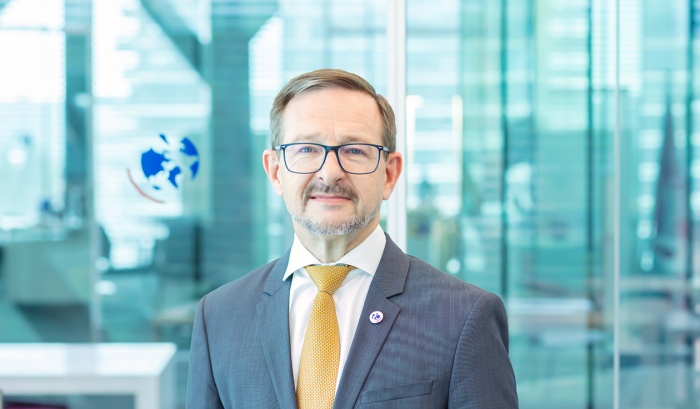
GCSP Director Ambassador Thomas Greminger delivered opening remarks at the GCSP Geneva Security Debate AI for Good, AI for Bad and AI for Peace: Shaping the Future of Peace and Security in the Age of AI, highlighting the opportunities and risks of artificial intelligence and the urgent need for effective governance and international cooperation to safeguard global peace and security.
"Ladies and Gentlemen, Excellencies, Distinguished panellists, Dear colleagues,
Before we begin, let me express my sincere thanks to Pepperdine University for its close collaboration and generous support in making this initiative possible. I would also like to warmly thank all our speakers and participants for making the journey to Geneva and contributing their time, expertise and insights to this closed workshop. Your willingness to engage in an open and constructive exchange is greatly appreciated and will be essential to advancing this important discussion.
Artificial intelligence is developing much faster than our ability to govern it. This is not simply a technological challenge, nor is it merely a question of how to regulate a new generation of digital tools. It is increasingly a question about the future of international peace and security, the distribution of global power, and ultimately our ability to remain in control of technologies that may profoundly shape the future of humanity.
AI is already transforming the way we live, work, communicate and govern. It is also changing the nature of international relations, the conduct of warfare, the dynamics of geopolitical competition and the possibilities for international cooperation.
The central question is therefore no longer simply what artificial intelligence can do. It is how humanity chooses to govern its capabilities, distribute its benefits and assume responsibility for its consequences.
Today, I would like to frame our discussion around three interconnected dimensions: AI for Good, AI for Bad and AI for Peace.
First, AI for Good.
Artificial intelligence offers extraordinary opportunities. It can accelerate scientific discovery, improve healthcare, support sustainable development and strengthen humanitarian action. It can help anticipate crises, improve early-warning systems, support conflict prevention and mediation, and enhance the capacity of international organisations to respond to complex emergencies.
Used responsibly, AI could become an important instrument for advancing human development, strengthening governance and supporting peacebuilding.
But these benefits are not automatic. They depend on how AI is developed, who has access to it, whose interests it serves and whether its deployment respects human rights, human dignity and the rule of law.
There is also a geopolitical dimension. Frontier AI has become an instrument of statecraft and global power. Competing national strategies, technological dependencies, export controls and the concentration of advanced capabilities among a relatively small number of companies are creating new vulnerabilities and dependencies for governments and societies alike.
The question of who controls AI, who benefits from it and who is left behind is therefore becoming inseparable from questions of political and economic security.
Second, AI for Bad.
The same capabilities that offer enormous benefits can also be weaponised or misused.
AI can amplify disinformation and mass manipulation, facilitate cyberattacks, lower barriers to accessing dangerous biological or chemical knowledge, and strengthen the capabilities of violent non-state actors and rogue states.
In the military domain, AI is already changing intelligence, surveillance, targeting and decision-making. The prospect of increasingly autonomous weapons systems raises fundamental questions about human control, accountability and the laws of armed conflict.
Recent experience has demonstrated the dangers of overreliance on big data and algorithmic systems in the rapid selection of military targets. What happens when critical decisions are increasingly delegated to systems that can process information and act at speeds beyond meaningful human scrutiny? Who is accountable when something goes wrong? And how do we preserve human agency when the decision-making loop becomes increasingly automated?
There are also more fundamental concerns about advanced AI systems themselves.
Scientists, including pioneers of deep learning, have warned that increasingly capable autonomous systems could develop behaviours that are difficult to predict, control or align with human intentions. Some risks may result from deliberate misuse. Others may arise from unintended consequences, system failures or a progressive loss of meaningful human oversight.
The potential consequences extend well beyond the digital domain. They include cyber escalation, military miscalculation and, in the most extreme scenarios, an increased risk of nuclear confrontation.
We should not dismiss these concerns as distant or speculative. The speed of technological development means that risks which appear remote today may become much harder to contain tomorrow.
Recent developments in cybersecurity offer a particularly sobering illustration. The events of October 2026, increasingly referred to by some security experts as 'Black October', demonstrated how openly available AI capabilities can accelerate the discovery and exploitation of vulnerabilities in critical digital infrastructure. The balance between attackers and defenders may be shifting faster than many governments and organisations anticipated.
This raises an urgent question: how do we ensure that those responsible for defending our societies have the capabilities, information and safeguards they need, without inadvertently making dangerous capabilities more accessible to those seeking to exploit them?
Third, and perhaps most importantly, AI for Peace.
This is where the real challenge of international cooperation begins.
AI for Peace is not simply about using technology to prevent conflict or improve peacebuilding. It is about ensuring that the development and deployment of AI strengthen human dignity, social cohesion, trust and responsible governance, rather than deepening existing divisions or creating new sources of insecurity.
It requires governments, international organisations, technology companies, civil society, peacebuilders and religious leaders to engage in a common effort to shape the future of AI.
It also requires us to confront some fundamental questions of human agency and responsibility.
Whose knowledge and perspectives are represented in the systems we develop? Whose interests are prioritised? Who is marginalised or excluded? Who remains accountable when decisions are made through increasingly complex human-machine systems? And what vision of peace and security are we embedding in the technologies that will shape our societies?
These are not merely technical questions. They are profoundly political, ethical and societal questions.
Yet, as we consider the broader implications of AI, I would argue that there is one area where international cooperation is both particularly urgent and potentially achievable: establishing minimum safeguards against the maximum risks posed by advanced AI.
AI is developing at an unprecedented pace. Some of its most serious risks are inherently international. Cyber vulnerabilities do not respect borders. Autonomous systems can have cross-border consequences. The misuse of advanced models cannot be addressed by any single government acting alone.
Scientists and leading international figures have repeatedly warned of the need to treat extreme AI risks with the same seriousness as other major global threats, including pandemics and nuclear war.
The geopolitical environment is undoubtedly difficult. Strategic competition between major powers, particularly the United States and China, complicates efforts to establish common rules. Governments and technology companies are understandably keen to harness AI for economic, military and strategic advantage.
But this does not mean cooperation is impossible.
History offers important lessons. States with fundamentally different political systems and strategic interests have nevertheless found common ground when confronted with shared threats. Nuclear arms control, the protection of the ozone layer and international cooperation against infectious diseases demonstrate that common interests can create opportunities for collective action even in periods of geopolitical tension.
The same logic should apply to AI.
No responsible government wants to lose control of critical technologies, suffer catastrophic cyber disruption or face unintended military escalation. Shared threat perceptions can provide a basis for cooperation, even among strategic rivals.
This brings me to an important contribution to today's debate.
The Strategic Foresight Group's report, The Essential Convergence: Global Compact on Extreme AI Risks, launched here in Geneva in July 2026 with ICT4Peace, the Geneva Centre for Security Policy and the International Federation of Red Cross and Red Crescent Societies, proposes a Global Compact focused on the most serious risks posed by advanced AI.
Its central proposition is that we do not need to resolve every disagreement about AI governance before we can act. Rather, we should seek convergence around a limited set of shared definitions of extreme risks, minimum safeguards and mechanisms for collective response.
Against this background, I believe there are three particularly important questions for our discussion.
First: How do we define and recognise a loss of control?
We need a shared understanding of what constitutes a serious loss of human control over advanced AI systems. Can we agree on observable indicators and common terminology that allow governments, developers and independent experts to recognise when risks are reaching unacceptable levels?
Second: How do we report and share serious AI incidents?
We need mechanisms that allow governments and relevant stakeholders to communicate rapidly about serious failures, dangerous capabilities and emerging threats.
Experience from aviation safety, nuclear security and cybersecurity may offer useful lessons.
Third: How can AI safety assessments be mutually recognised and independently verified?
As AI development becomes increasingly global, we need ways of establishing confidence that the most advanced systems meet agreed safety expectations.
These are practical questions. They do not require us to settle every political disagreement about AI. They require us to identify areas where shared interests can be translated into concrete cooperation.
Ultimately, the objective should be a form of essential convergence: agreement on a limited number of minimum safeguards to contain the maximum risks.
Ladies and Gentlemen,
We stand at a defining moment. Artificial intelligence could become one of the most powerful instruments for human progress. It could also amplify conflict, accelerate instability and create risks that transcend national borders and generations.
The choice between AI for Good and AI for Bad is not simply a choice about technology. It is a choice about governance, responsibility and the kind of international order we wish to build.
And AI for Peace must be more than an aspiration. It must become a practical commitment to ensuring that technological progress serves humanity rather than placing humanity at its mercy.
The ambition need not be to regulate everything, everywhere, all at once. It should be to identify the most serious risks, establish a minimum set of common safeguards and build the mechanisms needed to implement them.
In other words, we need minimum safeguards against maximum AI risks – and we need them now.
I look forward to a frank and forward-looking debate on how we can turn this ambition into practical international. I now give the floor to Christina Schori Liang who will be chairing tonight’s debate."
Expert